Many families begin by comparing prices, reviews and sales rankings for straight, L-shaped and flip-up grab bars. Only after installation do they discover that the user never reaches toward the bar when rising.
The problem is often not whether the bar is good or bad. It is whether the support appears at the point where the user is most likely to lose balance.
Before comparing shapes, ask: who will use it, what movement must they complete, where is that movement least stable, where does the hand naturally reach, and can that part of the wall provide a reliable fixing?
IanCare’s sequence is simple: person, movement, space, then product.
Straight, L-shaped and flip-up bars provide different support directions, cover different movement patterns and require different installation conditions. Having a bar on the wall does not mean it will be useful when it is needed.
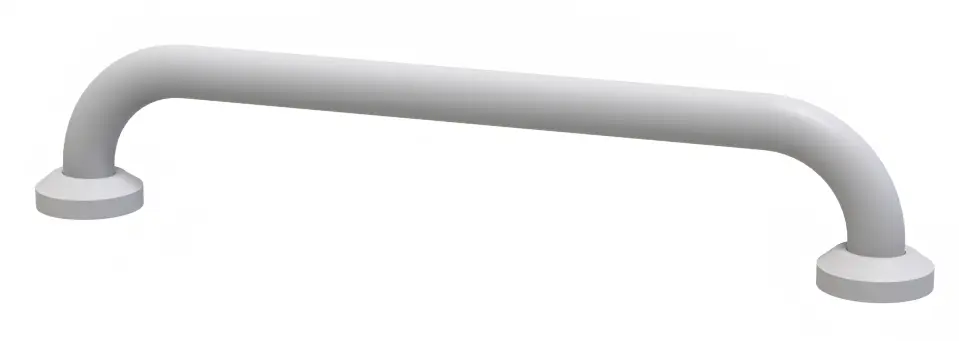
Straight grab bars: for a clear direction of support
A straight grab bar can be installed horizontally, vertically or diagonally to provide a defined grip direction.
It may suit crossing a shower threshold, maintaining balance while showering, moving a short distance along a wall, or providing one clear grip point while sitting or rising.
The key question is not simply whether the bar is horizontal or vertical. It is where the user’s hand naturally reaches during the risky movement. One person reaches forward while entering the shower; another pulls upward from a shower chair; another needs a horizontal grip while moving sideways.
A single straight bar may not cover a movement that combines rising, turning and lateral movement.
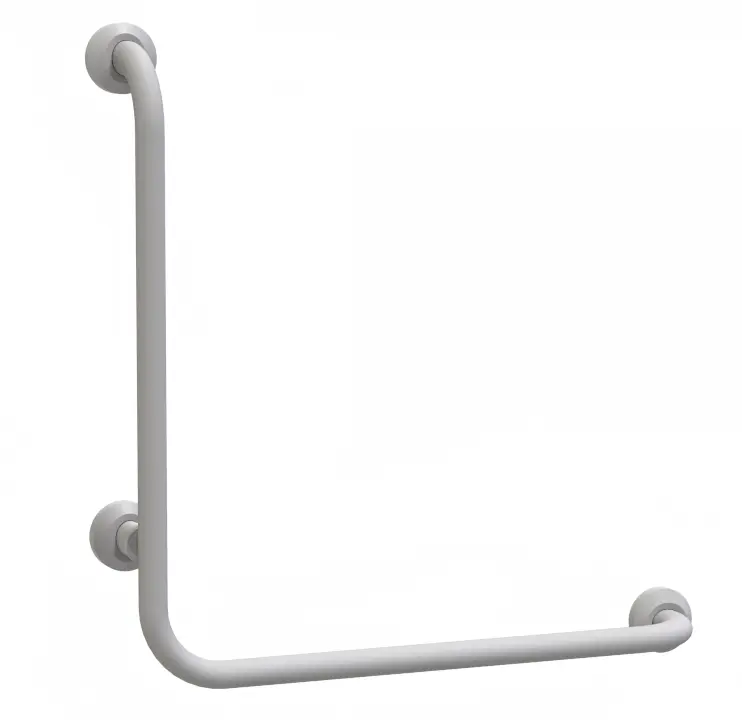
L-shaped grab bars: when the grip direction changes
An L-shaped grab bar combines horizontal and vertical grip zones. It can suit a continuous sequence such as pulling, pushing and then stabilising in standing.
Beside a toilet, one person may first use a lower section for stability and then adjust their centre of mass along the vertical section. Another may still need the horizontal section after standing. The two directions can support different stages of the same movement.
An L-shaped bar is not automatically the right answer for every toilet. Check the user’s preferred hand, stronger side, distance between the toilet and wall, direction of body movement, reliable fixing locations, circulation and cleaning access.
These points cannot be established from a room photograph alone. The user’s real movement should be observed.
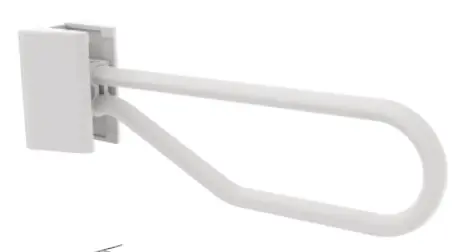
Flip-up grab bars: side support while preserving clear space
A flip-up grab bar is wall-mounted on the left or right side of the toilet. It is lowered for use and raised when circulation or caregiver space needs to be clear.
It may suit a longer support zone beside the toilet, a compact bathroom where the bar cannot permanently occupy the route, lateral wheelchair transfer, side assistance from a caregiver, or a bathroom shared by people with different mobility needs.
Review the side wall, mounting plate, pivot, usable reach and clearance in the raised position. A flip-up bar is not a rail placed across the front of the toilet. When lowered, it must be where the user can naturally grip and push down.
If both sides have suitable space and the user genuinely needs bilateral support, assess one or two bars. More bars are not automatically safer: a poor position can obstruct turning, transfer or assistance.
Choosing toilet support: review the full movement chain
Toilet areas are easy to get wrong. Watch the complete sequence: approach, turn, controlled descent, whether rising depends on pulling or pushing down, stability after standing, wheelchair transfer and caregiver assistance.
- If one clear grip direction is enough, a straight bar may be suitable.
- If sitting, rising and standing require different grip directions, consider an L-shaped bar.
- If longer side support is needed while circulation or transfer space must remain clear, consider a flip-up bar.
Then add the user’s stronger and weaker sides, toilet height, wall position and care method to the decision.
Choosing shower support: standing, seated or transferring?
Do not judge a shower area by floor size alone. Establish whether the person showers standing, showers seated, or transfers to a shower chair.
Observe thresholds, wet-floor instability, hand reach while turning, controlled descent onto the chair, the force direction used when rising, and possible conflicts with the shower fittings or screen.
A straight bar supports a clear grip direction. An L-shaped bar can cover a sequence involving standing, sitting and rising. Flip-up bars are primarily associated with toilet-side use; any other use needs a separate review of the product, installation and movement.
Why one installation height does not fit everyone
Common installation dimensions can inform a review, but should not be copied without context.
User height, reach, lower-limb strength, toilet or shower-seat height, preferred hand and mobility pattern all affect the useful grip zone. Two identical rooms can require different solutions.
With appropriate protection, have the person simulate sitting, rising, turning and moving. Identify the least stable phase, observe where the hand reaches, and then confirm that a reliable substrate is available before deciding the bar type, direction and height.
The wall and fixing matter more than the outline
When a grab bar is loaded, the force is transferred into its fixings and the wall.
Check the substrate, whether the surface finish conceals a suitable structure, compatibility between the mounting plate, fasteners and wall, concealed services, post-installation inspection, and any looseness, deformation or unusual noise during use.
Do not treat “installed” as synonymous with “safe.” Where the bar provides primary rising support or supports body-weight transfer, use appropriately experienced assessment and installation personnel.
Suction grab bars: an aid, not a universal primary support
Suction and fixed grab bars are not simple substitutes.
Suitability depends on the specific product instructions, wall surface, flatness, installation condition and intended use. A suction bar should not be described broadly as the primary weight-bearing aid for everyone.
If the user applies sustained force while rising or transferring, first assess a reliably fixed solution and the wall structure. Product-specific evidence cannot be generalised across every model.
Frequently asked questions
Should I fit a straight or L-shaped grab bar beside the toilet?
A straight bar may be enough when one clear grip direction is needed. An L-shaped bar can cover a sequence that changes from sitting to rising and then standing. The final choice still depends on the user, toilet position and wall structure.
Which side of the toilet should a flip-up grab bar be installed on?
It is normally wall-mounted on the left or right side of the toilet. The correct side depends on hand preference, stronger and weaker sides, wheelchair transfer direction, caregiver position and the available wall.
Are more grab bars always safer?
No. Too many bars, or bars in the wrong positions, can obstruct circulation, turning, cleaning, wheelchair transfer and caregiver assistance. The priority is to support the movement that actually presents a risk.
Can a fixed grab bar be installed on a tiled wall?
Tile alone does not establish that the fixing is reliable. The substrate behind the tile, the fixing method, the fasteners and the installation location all need to be checked.
Does a toilet need grab bars on both sides?
Not necessarily. Consider whether the user needs two-handed support, has one-sided weakness, transfers from a wheelchair, and whether the room has enough clear space.
Do grab bars need checking after installation?
Yes. Check the mounting points, fasteners and bar for looseness, deformation or unusual noise. Stop relying on the bar and arrange corrective work if anything abnormal is found.
Final point
No one shape is universally better.
The right grab bar is the one that supports the movement and location where the user needs it, through a reliable wall and installation.
Before choosing, record the user’s mobility, the least stable movement, the toilet, shower and shower-seat positions, room photographs and dimensions, and the wall and existing fittings.
That information usually leads to a safer decision than choosing the product first.
General information only. It does not replace clinical or rehabilitation assessment, construction design, product instructions or mandatory local requirements.